Showing posts with label fermentation. Show all posts

Tuesday, March 4, 2014

The (Belgian) Bounce is Back.


It's been about three or four weeks in bottles, and I think this one is on track.  This could be the one, you guys.  It's a lovely light color, with just the faintest haze.  The taste is good, not mind-altering yet, but it is reminiscent of that legendary first batch in the first few weeks.  Now I must leave it be as long as I can stand; three months is when the magic starts to happen.

This is a Belgian Abbey Tripel: clear and light in color, but full of aromatic flavor and fairly high in alcohol content.  A fairly warm fermentation and the addition of some sugar give this beer a kick you don't taste right away, but definitely feel.  

Monday, February 24, 2014

Kim-Kim-Ka-Chi, Kim-Kim-Ka-Chi

Good luck will rub off when you shake hands with me.

But right after I've been making this stuff there will be a lot of garlic, ginger, and hot sauce that rubs off with that good luck.  Maybe that's what good luck is...

This was the thickest batch of kimchi sauce I've made yet.  I've been adding more rice every time (which is twice) and it seemed to get better, so under the doctrine of "you don't know how much is enough until you know how much is too much," there's a lot of rice in this batch, which made it really thick.  

I added cucumber to this batch, which was a suggestion from a coworker who said he had cuke's in kimchi once, and couldn't find them anywhere.  We'll see how it goes.  Also, I put a burdock root into this batch.  When we were at the Food Hole picking up ingredients, I said "Ooo, burdock root, I'll put some of that in it."  Ma femme asked what it tasted like, and I said "I have no idea."  Fresh, it tastes like a really sweet delicious carrot with none of whatever it is that makes carrots taste like carrot.  Funny that I always considered burdock to be a weed.  Maybe if I had known they were so delicious, I would have thought different.  The sheep always loved them; you'd turn them into a new pasture, and the really experienced ones would head right out into the open areas and eat the burdock first.  We would pick big leaves and take them into the barn as a treat, and they would devour them.  I tried to eat the leaves, and they were really awfull, so I never understood what the sheep saw in them.  I suppose some would say the same about the kimchi I'm making; there's no accounting for taste.  

Run Rocks Rhymes

Peter Piper's got nothing on these.


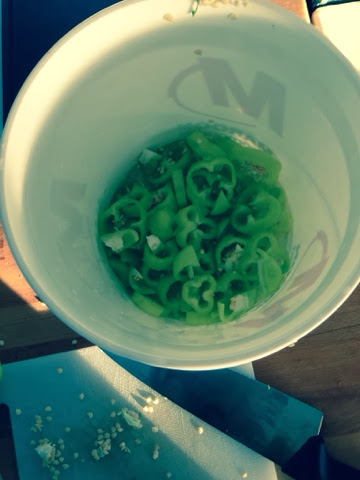
Several nice big banana peppers, sliced into rings; a couple heads of garlic, husked and smashed, a bit of salt, and just enough water to cover.  Then the age-old pickling routine: weight, wait, great.

Actually, they are a little soft and not hot enough.  I think for the next batch, I should add some hotter peppers.  I'm also going to experiment with making a small fraction of the brine with some live vinegar.  Not so much that they are "pickled" by it, but I'm looking for ways to reduce the salt content and add bacterial diversity.


They'll be great on burgers or hot dogs, or on some juicy barbecue.  I'll probably end up taking them a serving at a time in with my lunch to work.  A nice salty snack for warmer months.

Thursday, February 20, 2014

Gingerlicious

The wild-fermented ginger beer in bottles.


It's so gingery.  Holy moley.  If you are not super-into ginger, this is not for you.  It is also coming out flat, which is disappointing, since I primed the crap out of it.  Perhaps it needs more time, but it's been a few weeks, it should be done.  I think next time I am going to add way more than 3 lbs of palm sugar for a stronger drink.  Still good, though.

Wine in Line

Second Malbec bottled: 


Cabernet Sauvignon begun:


I've learned a few things, and got a few good tips at a Northern Brewer mead class.  Number one: I think I leave my oak in too long.  After 6 weeks it starts to impart a woody flavor.  In a bad way, like actually sucking on a piece of wood.  So I'm going to rack it out of there before that happens.  Also, more racking, more better, so I'll probably try a tertiary, quaternary, whatever-five-is-ary, until it's as clear and well-aged as I want it to be.  I think a little exposure to oxygen is a good thing for wine, too.  It helps keep fermentation going, and you actually want it to oxidize a little, apparently, especially for reds.  And shaking is a good thing for wine.  It helps degas and keeps things well mixed, which also supports strong and complete fermentation.  In later stages of racking, I will probably also degas with my whip-on-a-drill mixer.  Wine is pretty great.

Sunday, February 9, 2014

Fermentation exchange

Part of the Fermentation Revival/Revolution is the building up of community around the things we ferment.  In this case, I've traded kimchi for pickles.  This fall, my coworker Susan gave me some Napa cabbage from her garden, which I turned into delicious kimchi.  I gave a jar of it to her, and she gave me a jar of these Chinese pickles which she made.  They have a brown sweetness that I can't quite put my finger on, other than that they are "Asian."


I'm beginning to wonder if I like traditional pickles any more.  There are a few brands I still love, particularly Bubbies from San Francisco, but something tells me I just don't like the texture of fermented cucumbers.  This is reinforced by how much I love the texture and taste of fermented cabbage.  I am excited to try some fermented kale and collards out of my own garden this summer.


Tuesday, December 24, 2013

Ginger Beer w/ Ginger Bug

Alright, let's get started.  This is going to be my version of Ginger Beer with Ginger Bug from Sandor Katz's Art of Fermentation.  Step 1 was to make the starter, which can be found in a previous post.  Step 2 is to grate the ginger:


...lots of Ginger.  The original recommendation is for a 3" - 4" piece of ginger for each gallon of finished ginger beer, but I have got significantly more than that.  I grated it up and put it in my big brewing pot with about 2 1/2 gallons of water and started heating it up.


My stove doesn't quite have the power to get a real boil going in this giant pot, but it gets hot.  Next I added the palm sugar which is in little round pucks.  I bought a 3.3 lb jar from the Asian grocery where I got the ginger.  I don't think that's going to make it very strong from an alcohol perspective, but this is going to be more of a "tonic" beverage than a real beer.  I hope you like ginger...


I gave it about 15 minutes of "almost boiling" after the sugar was fully dissolved, then cut the heat, added another gallon of cool water to start bringing the temperature down, and started draining it into a clean carboy.  As expected, the hose flowed freely for a while, but eventually got clogged with ginger chunks.  Ma femme had a great suggestion to use a strainer/slotted spoon over the intake, and after that, all the liquid drained out with no problem.  We scooped it out into a big strainer:


and poured the rest of the water to make up 6 gallons through the pulp, including a couple rinses in the big pot to get all the sugar.  I had originally intended to put all the ginger in there with it, but there's no good, quick way to get chunks of junk into a carboy... let alone get it out a month from now.

By the end of the night, it had cooled to body temperature (maybe a little higher) so the starter went in, and the air lock went on.  Hopefully it starts bubbling away.  Adventure!


Vinegar Cycle

I can make vinegar!  

Really it's the bacteria.  

I can set up conditions hospitable to the organisms that make vinegar!


On the left is my second(!) batch of Czech Pilsner malt vinegar.  I may have mentioned that this beer tastes like wet newspapers.  That grossness is totally gone in the vinegar.  I made some salad dressing with the first batch and it was really good.  It does not seem as strong as the store-bought 5% vinegar, but I don't know yet whether that's because it's really not as strong or if it's still got some sugars and alcohol in it because it's still young.  Learning!

On the right is the Ginger Bug starter that will go into my Ginger Beer.  It's starting to get actively bubbly, so I think it's time to get on with the brewing for that.  But this post is about vinegar...


Here I'm starting a new batch of malt vinegar using some Kentucky Bourbon Barrel Porter that tastes like ashes from too much black malt.  I started it with 1 bottle of beer, ~6 oz of "finished" malt vinegar with its mother, and 1/4 cup of table sugar.  Degas the beer, stir in the sugar, pour in the vinegar, and plop in the mother.  I put finished in quotes, since the fact that this batch regrew its own mother just a week after being strained from its old mother tells me that it's not completely finished; also, as I mentioned above, it's not as strong as some of the commercial vinegars I have.

The addition of a significant amount of finished vinegar helps acidify the mix right away and prevent the growth of mold until a new colony of bacteria can get established.  I'm starting to get a cycle going, and pretty soon I want to have three or four kinds of vinegar going, one bottle finished in use, and one batch with the mother colony in process.  Then when it's ready, I can split the active batch, strain some for use, and feed the rest with more beer/wine/cider/etc to keep things going.  Vinegar also seems like a great thing to give away once things get going.

Saturday, December 7, 2013

Ginger Beer Starter

I was reading the Sour Tonic Beverage chapter in The Art of Fermentation on the plane to DC and one of the things that stuck out in my mind was something he called "Ginger Beer with Ginger Bug."   The Ginger Beer is the resulting beverage, and the Ginger Bug is the starter, or probably more accurately the unique combination of yeast and bacteria that populate the surface of ginger roots; which you feed and propagate into the starter; which you feed and propagate into the Ginger Beer.


I went to an Asian grocery that I have driven past many times but never visited to acquire the ginger.  While perusing the isles, I came upon palm sugar which I decided to get as the fermentable portion of this concoction.  It has a roast-y caramel-y taste, which combined with the smooth but grainy texture reminds me of some of my past attempts to make caramel corn topping that crystallized.  It is formed into little half-rounds that must be the shape of some cooling tray it was poured into during processing.  Perhaps it no longer needs to be made that way, but hey, that's how palm sugar comes...

I also bought several pounds of ginger, and I have my fingers crossed, since Katz mentions his suspicions that much of the ginger that comes into the US is irradiated (therefore sterile) and that you need organic to make the starter (once it's going you can use anything for the bulk of it.)  I grated a couple medium-sized nodules and crushed up half a chunk of palm sugar, covered it with water to make a slurry, cheeseclothed it, and into the cupboard it goes.

I also fell victim to the siren song of the roasted pork belly under heat lamps behind the counter at Rhino Foods.  I asked for "one half pound" and walked out with one AND a half pounds.  Luckily it is delicious, and the whole experience is worth it for a taste of the chili-onion-hot-pepper-fish-sauce it came with.

Rhythm of Renewal

I've had my first real success with vinegar.  Other people who talk and write about vinegar make it sound as easy as falling off a log, but it has eluded me.  I got a nice robust new mother to grow on a jar of old beer and it fell the other day, so I tasted it and it's great.   

It's ready to use, but of course it's full of mother and sludge, so pictured below is the following process of filtration and renewal:  on the left is a coffee filter slowly separating the finished vinegar from all the mother and sundry other gunks.  In the center is the remainder of the unfiltered vinegar waiting its turn to be strained, and on the right are two more bottles of beer poured into a gallon tub to degas and receive the solids in the coffee filter and turn into *more vinegar.*

I also added 1/4 cup of sugar to the 24 fl. oz. of beer to give the bacteria something to munch on besides ethanol and hope.  Now the cheese cloth goes back on and the jar goes back on the shelf.  I'm thinking that this batch should go a little faster since I'm putting more mother in (the initial chunk plus what grew this time) and the particular bacteria that did well on this particular diet of beer should be right at home.  For now...  we wait...

Oh. My. Gaah.


We've entered a new era.  One in which I can make awesome Kimchi.  I know it looks like garbage (please do not inquire about how it smells) but it is so good.  The brine is good, the crunch is there but things are definitely "tenderized," the salt level is nice, the spice is just about right-on; it's the whole package, and I'm really proud of it.  

The best part is that my second batch, which I transferred last night from the initial fermenting bucket with jug weight to glass jars, is even better!  I think I don't really like the taste from the daikon in the first batch.  I've never really liked radishes, and while whatever harsh flavor they had is definitely faded, there's still a radish-funk that I'm not totally into.  Totally edible, though.  Totally.  Oh, and a shout out to Susan where I work who grew the napa cabbage (which she called bok choy) for the second batch.  Teamwork.  I need to get her some, but I'll probably put it in a pint jar... it's too good to give away too much.

Wednesday, November 27, 2013

Updates in Jars

First, the preserved lemons.  I'm not calling these pickled lemons for some reason, I think because they are so salty; but then what's pickling?  There's definitely some bacterial activity going on, because it's building pressure and releasing gas when I loosen the lid.  I did not put it in the refrigerator, as recommended by the recipe, it's been in a cabinet under the counter, in the dark, relatively cool.  I opened it once or twice, and the lemons are definitely softer and somehow "greasier" if that's possible.  Also, now, after a week, they are yellower, too; more "lemon-colored."  The jar is usually pressurized a little when I look at it, and I always open the lid *just* until it vents some gas.  it always heaves a sigh of relief and bubbles a little bit.  Sometimes I think it's just air slowly escaping from the pulp of the rind, but the pressure buildup tells me there's definitely lactic acid bacteria afoot.  I want to rush out and fill another dozen jars with lemons, but not until I cook something that calls for preserved lemons.


Next, Vinegars.  There seem to be conflicting reports out there about exactly how long and under what conditions vinegar is made.  The instructor and several people I talked to in Reedsburg said it took weeks or less.  Some of my vinegars have been going for nearly two months.  Admittedly, they are in my basement which is in the low 60s, but I've got them above my furnace, which is the warmest spot.  I'm just now starting to see what looks like a thin film of mother starting to form on a couple of them.

Other sources indicate that it takes much longer to make vinegar.  The Cooks Illustrated DIY book mentions 3 months in a crock, and talking about it with my mom on the phone over the weekend, she said her grandparents used to make vinegar, and it took all winter in the basement.  She also said they guarded the mother with their lives, I assume until they could get another batch going.  The Kentucky Housewife Cookbook (from 18-who-knows-when) lists a recipe for vinegar something along the lines of: "in the fall, throw all your apple cores into an open topped barrel.  Set it under a tree, out of the sun, but where it fill with rainwater.  By the middle of the next summer, it will be vinegar."  For real.


I think my results are more in line with the second set.  I made some salad dressing with the Concord grape vinegar I got from my Fermentation Fest friend, and it was darn good.  I really hope my batches take off and I can get some real production going.  I have a couple cases of questionable beer bottled that I would *love* to turn into vinegar, and I think I would make a quart of vinegar out of every batch of wine I make.  Come on, acetobacter.


Monday, November 25, 2013

To Port, Mr. Sherry

The Port is in bottles:


It is a syrupy delicious mess.  The original label file had January 2013 on them, so I've thinking about bottling this for at least 11 months.  I tasted it once before when we transferred it and added the oak spiral, and it's even better.  Maybe I would say it's a little sweet, but hey: it's Port.  I don't get much of the oak, but it definitely tastes well aged, and I think it will just get better.  The thing I am most impressed with is the color.  In the glass it's nice and burgundy purple, but when it you tip it or get down to the last bits, it has a gorgeous brown tone.

Moving on, the Belgian looks wonderful in primary: 


with a golden honey color and a kreusen like a cloud.  About 12 hours after this picture, it had pushed a bunch of foam up and out of the blowoff hose and had started to settle back down.  So I added a pound of sugar.