Sunday, March 19, 2017

Brew Day of Long Mashing

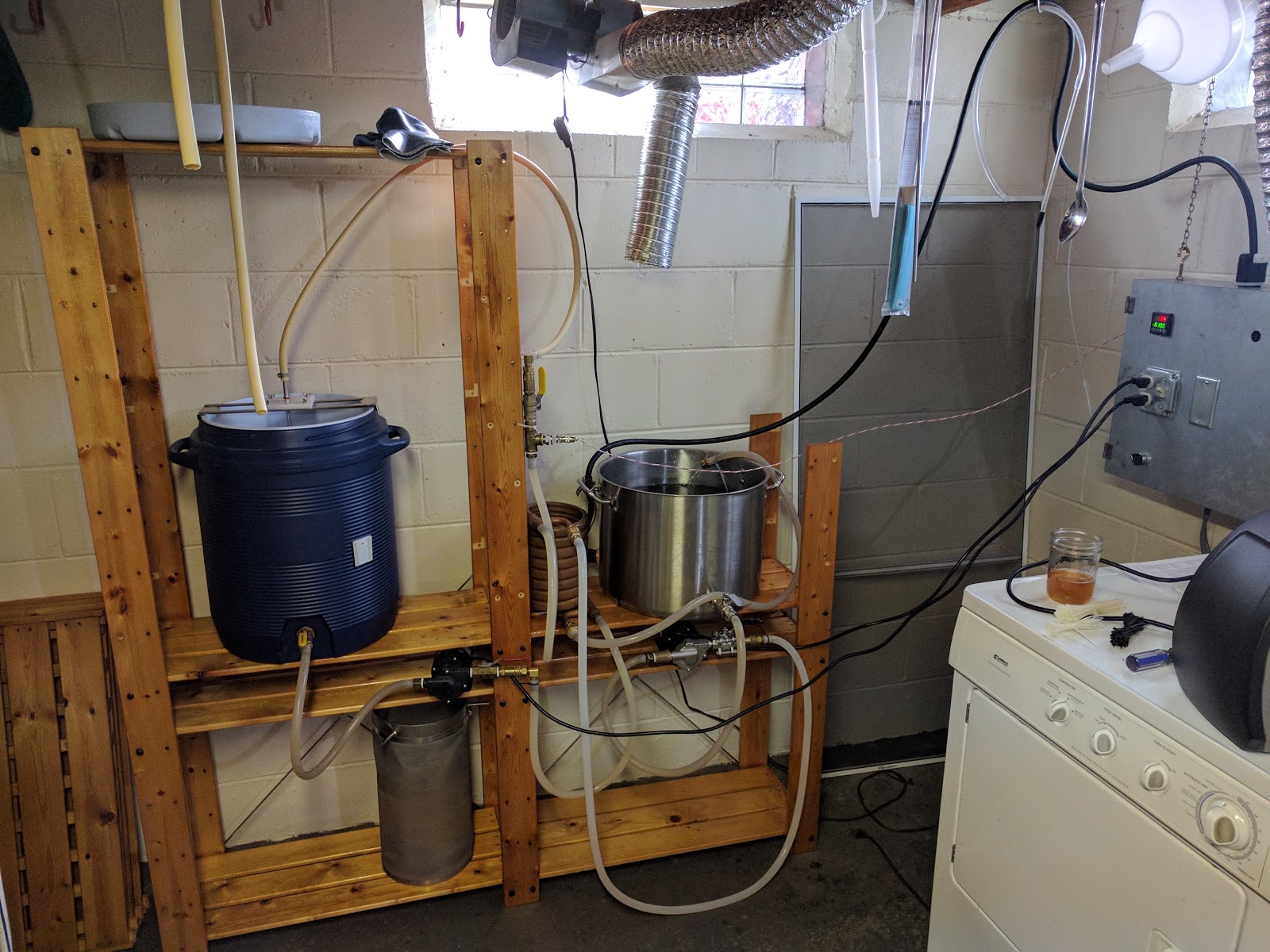
Today was a brew day, and on deck was a sour beer in the Belgian Lambic style, but first a word about the brew system.  The stainless kettle on the right has a PID controlled 5 kW element heating it, and clean water is circulated through the "outside" of a counterflow chiller (or in this mode, counterflow heater.)  Let's just say heat-exchanger.  The blue mash tun on the left has a false bottom and circulates wort through the inside of the counterflow, bringing it up to the temperature in the heated kettle, hopefully close to the set point on the controller.  This is my conception of the classic "three vessel system" with just two vessels, except for the fact that I use the red cooler on the bottom as a sparge vessel, so it *is* three vessels, but one of them is totally passive.

 Here's another shot showing the exhaust fan to try and help take some of the steam out of the room through an adapter to the dryer vent.  Technically I can't really brew and do laundry, but those are the sacrifices we make.
 On to the beer!  Grain Bill:

3 lbs Raw Wheat
5 lbs Pale Malt

Lambic grain bills tend to use 30% - 40% raw wheat, and I liked this because it is a nice 3/8:5/8 ratio (37.5% wheat.)  I think I was also supposed to use Pilsner as the base malt, but oh well, there will be a next time.  It was hopped with Williamette, 2.5 oz at 120 minutes.  Lambics are supposed to be made with aged hops, so these were in a paper bag on top of the furnace for about a week.  Probably not aged enough, and the wort does taste hoppier than I wanted, but hopefully it will fade in the finished product.  It came out looking great after a vigorous boil, with a dark blond color and crystal white head.

Here's the brew day schedule, which is a nice addition to what I usually do, i.e. unrecorded chaos.  It's a little hard to read, but the basic rundown is dough-in at 111 °F.  This is really low, but there's a ton of raw wheat to work on, and you're supposed to do a turbid mash to lock in some starch to feed the wild microbes.  Then an 11 degree step-up every 15 minutes until you get to 166 °F, mostly because I liked the numerology of 111, 122, 133, 144, 155, and 166.  I let it go a full half hour at 166 °F, and by the time I started sparging, it had been a full two hour mash; you're looking for tannin extraction in a sour.  The boil was also two hours, to really cook things out and concentrate sugars.  All in all, it took 5 hours, but considering the double mash and double boil, I am really pleased with the time efficiency of this system.  Having all the right tubes in all the right places really helped.

Y'all want this party started, right?


Cantillon bottle harvest yeast starter.  It has been going for a week and there finally seems to be more live yeasties floating in it, and it is smelling sour today, like its mother bottle.  I think these bugs are slow, but I have heard they are thorough.

Wednesday, March 15, 2017

Hollow Brass

I got some new brass for the system; a few more sets of quick disconnects, and the 1/4" NPT / 1/2" hosebarb connectors I need to tie them in to everything else.  Both were somewhat tricky to find, but they work so well, it's worth it.

When I was originally thinking about the design and layout, I was going to go all stainless.  I have a couple stainless valves on some of my kettles, and a few stainless fittings here and there.  It's pretty painless to tack on a few extra dollars for one thing at a time, but when I started to add up how much a dozen stainless quick-connect couplers costs, plus valves, plus elbows and T's, it gets pretty scary.  I was still going to bite the bullet a few things at a time and just deal with it, and then I read somewhere that brass and other copper alloys are mildly antimicrobial.

https://en.wikipedia.org/wiki/Brass

I think breweries of any appreciable size use stainless steel because it can take basically unlimited cycles of almost any chemical at any concentration you want to throw at it.  So you can brew, pump caustic soda through it to eat all the organics off, flush and circulate an acid to get the scale.  These are the things one would need to know if he/she were running a brewery.

That's *Brewing*
I'm *Homebrewing*

So, kiss my brass.  Plus I kinda like how it looks.  I like it when it is new and shiny, and I like it when it's worn in with a nice patina.  A lot of the stuff I have gets a matte golden brown color; it's clean but it looks well used.

Sunday, March 12, 2017

The System is Up

New PID controller (no, not that PID, as ma femme suspected) and a new brewstand re-purposed after updating the shelves in our kitchen to something a little more NSF compliant.  Control panel is hung, pumps have a dedicated place to sit, and the whole thing just seems more like it belongs.  Like it is a complete unit, and not a bunch of pieces linked together with wire and hose.

I did a test run with plain water today, just to iron out the kinks and see where I need to lengthen or shorten a hose.  Or maybe where I need to add one of my limited number of quick-disconnects.  And how many more quick-disconnects I need to add to that limited number.  The system performed well, with the critical "end-of-mash-to-start-of-sparge" time around 15 minutes and "element-covered-to-full-boil" time around 20 minutes.  Since this was a no-grain run, it was never limited by pump speed, so I'll bet I can be at a boil before I'm even done sparging an actual batch.  There is very little fumbling around to figure out what to move when changing modes, so we are homing in on an ideal (to me) setup.

I need to add a quick-disconnect for sure where the wort leaves the counterflow, to facilitate the transition from circulating mash to sparge.  I was going to skip this as a theoretical exercise in today's test, but I'm glad I didn't since it was one of the most awkward parts of the run, and can be easily remedied.  All in all, we are in a good place.  Next week is go-time for Cantillon Clone 0.9.

Saturday, March 11, 2017

That is the Sound of Inevitability

So it turns out that after a couple years of trying and continuing to hate them, I like sour beers now.  Apparently all it took was a trip to Brussels.

Note the Cantillon in the above pic, that's one of the six I brought back with me.  Shortly after taking this photo, I opened it and pitched the dregs into a cup of starter wort.  I'll scale it up to a full sized yeast starter with the rest of a quart and brew a batch of lambic (65% pale / 35% raw wheat) next Saturday.


Tuesday, March 7, 2017

Random Post of Intent


I need to start blogging more.  Again.  I brought some Geuze home from Cantillon on my trip to Europe, and I want to try making it.  It's going to be awesome.

Monday, June 20, 2016

Now is the Summer of This Content

Bacon in its early stages.  For this year's attempt, I am going back to a dry salting, at a rate of 1.75% vs. the weight of meat.  Generous but not excessive amounts of ground black pepper were added, along with cumin and cayenne pepper.  

It looks great.  I was worried when I got the belly that it was so thin.  But wedging it into the cambro I got for makin' bacon seems to be contracting it and thickening things a little.  The salt is finding its way in, and the lean is pinking up nicely.  I suppose that must have a contractile effect?  There's a little bit of water in the bottom of the tub, but not really that much.

I'm about to quit my job.  It feels so good to be on the brink of a new beginning.  Very encouraging is how excited ma femme is for me.  I hope I get a lot done in my time off before whatever happens happens.  I have a list of Things to Clean, Things to Fix, and Things to Make.  They are full and filling up.  I shall not want for lack of things to do.